Joy Division’s ‘Unknown Pleasures’ Cover


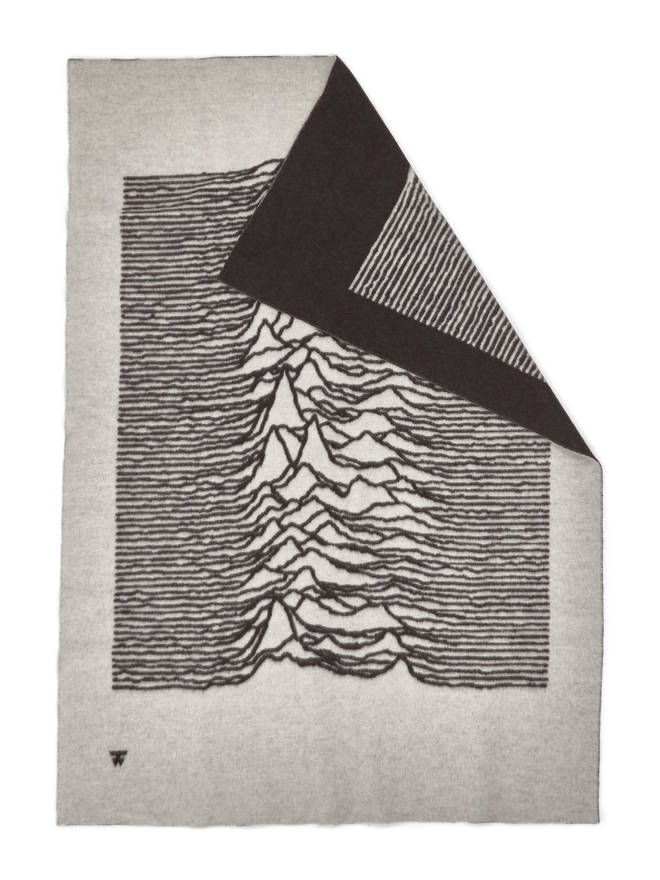
This is the cover art for Joy Division’s debut album Unknown Pleasures, which was released on June 15, 1979. Over the years, the image has been remixed and reinterpreted in pop culture, adapted countless times as T-shirts, running shoes, oven mitts and internet memes. 

The design is inspired by a “stacked plot” of the radio emissions given out by a pulsar, a “rotating neutron star”.

Unknown Pleasures blanket

Link to the podcast where the designer explains the origin and the meaning of the design.

Minimalism Artists

After taking this course, I realized how delivering ideas and stories with limited pen or paint lines is difficult as it sounds, and is very important. I found to very famous minimalism artists that I found very inspiring. The first artist is Yayoi Kusama, a Japanese contemporary artist. She works primarily in installation and sculpture. Her work is based in conceptual art, trying to express minimalism, feminism, abstract expressionism, surrealism, and others. When she was ten years old, she said she saw vivid hallucinations of “flashes of light, auras, or dense fields of dots.” Below are some of her famous art works!

The next artist I researched about is Carl Andre. He is an American minimalist artist famous for grid format and ordered linear sculptures. Varying in size, his sculptures also vary in installed areas — woods, indoors, floors.

Invisible Cities Illustrations

Italo Calvino’s 1972 novel, the Invisible Cities is known for its vivid recollections of cities in his style of narratives. His unique architectural language and sensory appealing vocabulary is captured in details. The most interesting thing about his writing was how he makes connection between the architecture and the nature’s omnipotence. Below are some illustrated versions of Calvino’s explanations based off the Invisible Cities

BETIL DAGDELEN

I really enjoyed Helen Frankenthaler exhibition last week; especially how most of her work did not have symmetrical or measured patterns, and how her work were free from mathematical measurements. I found another artist named Betil Dagdelen, who studies a pattern that could be called “metrical” patterns. All of Dagdelen’s works has no repetition, no hierarchic patterns, and has de-centered shapes creating a natural pattern like Helen Frankenthaler. I enjoyed watching these unique and independent shapes in every piece of work.

Relevant Artist –Kasimir Severinovich Malevich

Russian, 1879-1935

Biography

A pioneer of geometric abstraction, Kasimir Malevich wrote a manifesto, From Cubism to Suprematism: The New Realism in Painting, and founded the Suprematist movement in 1915. For Malevich, painting had to be free of political or social content, purely aesthetic, and concerned only with formal issues of line, shape, and color. Declaring his Black Square (1915) the “zero of form,” Malevich signaled an end to pictorial conventions and the origin of a new, modernist language of content-free forms. While Suprematism began before the Revolution of 1917, its influence was pervasive in the early Soviet period until the rise of Social Realism. Although Malevich eventually returned to representational painting, Suprematism had a huge impact on the development of abstract art in the both Soviet Union and in Western Europe.

Suprematist Works
Suprematism: Non-Objective Composition, 1915
Oil on canvas
31 1/2 × 31 1/2 in
80 × 80 cm

Relevant Artist – James Turrell

James Turrell’s manipulation of simple geometry and light creates a spiritual space. I awared my emotion being influenced by these colors and geometries. I think each geometry has some meaning embedded in it.

Red in different opacity and cocentric circles brings a feeling of energy flow and anxiety.

Blue square conveys a sense of calm and stable.

Triangle? Mysterious….