Representation in News

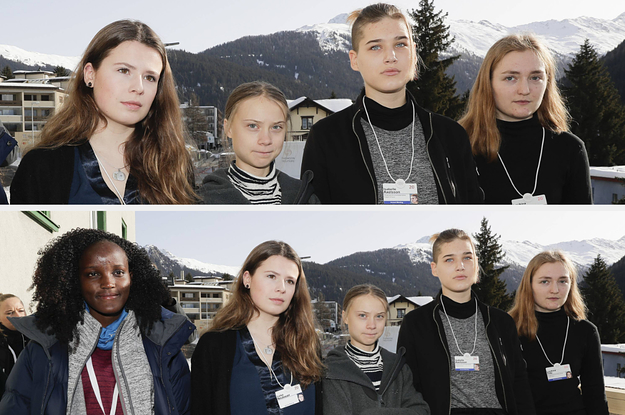
The cropped vs. un-cropped photos of climate activists in Davos on Jan. 24, 2020 (Photo by Markus Schreiber)

Representation in photography was a very recent issue in the news, as the Associated Press was criticized for cropping Ugandan climate activist Vanessa Natake out of an image that was published last week. As you can see, Natake was the only non-white activist in the photo. AP received significant pushback on social media and quickly changed the photo on their website.

Here is a link to a Buzzfeed news article about the incident: https://www.buzzfeednews.com/article/ikrd/vanessa-nakate-greta-thunberg-davos

And here is a link to the original AP article (now with the un-cropped photo in the gallery at the top): https://apnews.com/ee36c1b18874d3ebec2c743f0968396f

William Latham: 3D Modeling

Throughout the process of creating my designs for my “white noise” sound for project 1.1, I kept thinking about semi-imperfect repetition. White noise sounds to me like a seemingly endless, continuous sounds with slight variation throughout. After some additional thought, my mind kept returning to fractals and 3D modeling, which I imagined was an at least somewhat related artistic representation of what white noise could look like.

Below is the work of British digital artist and computer scientist William Latham. Latham uses complex computer technologies as well as genetic algorithms of organic life forms to create these fascinating, weird floating models. These designs of repetition and complexity in the midst of nothingness have inspired me to think more about how to possibly add depth to my designs.

Computer Plant Form 3, 1989
EvoArt session: PlantForm, 1989

Mark Rothko: Abstract Enigmas

When pondering over the idea of the simplest abstract works that convey the deepest of ideas, my mind comes to one artist: Mark Rothko. His beautiful yet simple works appear at first glance to be nothing more than a few colors, minimally placed on a canvas. But that is the magic of them. Rothko’s simplicity is meant to provoke deeper emotions in his work’s observers, demanding an active encounter that sparks deep, and distinct feelings in each individual commentator. Many of his seemingly plain canvases are created with multiple layers of different colors, providing them a certain glow that changes with more observation. One of his most famous exhibitions lies in Houston’s Rothko Chapel. Its series of black canvases call upon many spectators daily who view this non-denominational establishment as quite spiritual, a place to find deeper meaning about oneself.

Rothko Chapel, Houston, TX

A few abstract artists

Many people have probably seen some of Piet Mondrian’s (1872-1944) most famous works, such as the bold red, yellow, and blue blocks shown, but I was surprised at how much I also liked his other compositions upon re-discovering him.

Composition with Red, Blue, and Yellow
Composition in Grey, Pink and Blue

Also stumbled upon a contemporary abstract artist from Alabama: Walter Poole, who likes to work with depositing silver nitrate. According to his website, he donates 25% of his art sales to the World Wildlife Foundation.

Antamina
Celestial 3

Finding Inspiration From Microbes to Mosques

For our project 1.1 studies, I was drawn towards organic designs and consequently revisited an artist I follow for embroidery inspiration.

Emily Botelho (@salt_stitches) is a textile artist that creates strange alien-like worlds from myriad threads, beads, and fabric stitched with embroidery hoops. Each symphony of carefully placed beads and partial ‘pom pom’s from earthy, moss-inspired color palettes seems relevant to our exploration with layers and effects in Illustrator. In a soundscape or an acoustic environment, Botelho’s use of soft threads could translate to natural winds or the air-conditioner in the background. The cluttered beads could represent sharper and more distinct noises.

Botelho’s work reminded me of these colorful photos of microbes captured by synthetic biologist Tal Danino from the Synthetic Biological Systems Lab at New York City’s Columbia University.

Danino was able to create these patterns by manipulating the growing conditions for each bacteria. Harvard microbiologists Scott Chimileski and Roberto Kolter also captured photographs of microbiomes such as the koji microbe below which is used to make soy sauce, sake, and miso. This natural arrangement of the microbe’s spores almost already appears as an abstract art piece.

Koji, a fungus microbe

Another unlikely source of inspiration for project 1.1 came for me from the interiors of mosque domes. The repetition of intricate patterns in a circular form could be done in Illustrator using pathfinder.

Shaykh Lotfollah Mosque (Isfahan, Iran) [Photography by Rizzoli]

While mosque architecture seems to be more methodological and rigid than the organization of microbes or Botelho’s embroidery, its equally dizzying array of colors and almost clashing swirls and jagged lines create its own unique adventures for the eyes.

P. Valide Mosque Dome
Pertevniyal Valide Sultan Mosque (Istanbul, Turkey) [Photography by Harold Dixon]
Wazir Khan Mosque (Lahore, Pakistan) [Photography by Salman Arif]

Mattias Adolfsson

Mattias Adolfsson is a freelance Illustrator living in Sigtuna just outside of Stockholm Sweden.

His self-portrait.

He has worked with everything from computer games to children’s books. He has released 4 personal books, The second in line, from the sketchbooks of Mattias Adolfsson, published by Sanatorium won “most beautiful Swedish book” in 2014 and has won several other awards.

I found him on Instagram, Mattiasink ( https://www.instagram.com/mattiasink/). Watching him drawing releases my stress and its always interesting to see his imaginary creatures.

View this post on Instagram

192 Emoticons

A post shared by Mattias Adolfsson (@mattiasink) on

Some Emoticons he draw.

The complexity of his drawing is also very attracting.

View this post on Instagram

East meets West

A post shared by Mattias Adolfsson (@mattiasink) on

A complex one.

All his drawing is free-hand draw with foundation pen and ink. Here is some working process of the previous drawing.

View this post on Instagram

Dragons always attack from the east

A post shared by Mattias Adolfsson (@mattiasink) on

View this post on Instagram

More of the same

A post shared by Mattias Adolfsson (@mattiasink) on

FINALLY, all the great work come from practicing everyday and over years.

Relevant Artist – Paul Klee

Paul Klee is an Swiss-born German artist, influnenced by Expressionism, Cubism and Surrealism (wikipedia). He caught my attention when I saw an artist on social media shared his 3600 pages of color and composition theory research notes. The notes are available here: http://www.kleegestaltungslehre.zpk.org/ee/ZPK/BG/2012/02/23/006/. These are in German, but you can google translate.

A page of Paul Klee’s note.

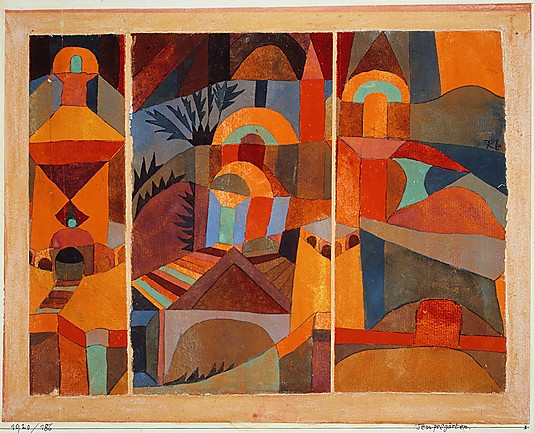
He painted cityscape using vibrant colors and mosaic color blocks. Many of his works have collaged his impression of city. (See more at Paul Klee’s Wikiart page: https://www.wikiart.org/en/paul-klee/red-and-white-domes-1914)

Red and White Domes

This Red and White Domes painting reminds me of a building in the different times of a day.

Hammamet with mosque
Southern (Tunisian) gardens
Temple Gardens