The Last Word: Illegal Art

The Last Word by Illegal Art was the work I was inspired by for my Tiny Monuments film. In a way, the artwork is also a ‘paper monument’ since it is made out of a lot of paper (and board). It consists of a board with numerous rolled up pieces of paper, either blank (indicated by the white end being visible to viewers) or with something written on it (indicated by the red end being visible).

The description of the artwork told viewers they could write (or draw) anything they wanted, whether humorous, meaningful, or sad. Tell a joke, a love confession, or just random thoughts; it’s the ‘last word’ in that once you return it to the board and walk away, you probably will not be able to find it back since another viewer will have viewed and moved it.

Illegal Art is a collective of artists that creates public art that involves participation to encourage self-reflection and human connection. For this reason, participation in each work has been simple like writing a thought down.

I think they are interesting to look at for our public art intervention project as well. I’ve added below two more works from them. The first is Incomplete, where anyone can use chalk to finish the incomplete sentence. The second is To Do, where people can come up and write on the post-it notes their to-do list. It is important to note that while the following two are public art and accessible to all, The Last Word requires payment to view and is thus private art (at least currently).

Illegal Art, “Incomplete” [Photo: Courtesy of Illegal Art]

The Monuments of Mel Chin: Conceptual Artist

Mel Chin is one of my favourite artists of all time so I’m glad to be able to post about him for a relevant project. He’s a conceptual artist whose works are commentaries on different aspects of human life such as nature, the environment and various social justice issues. Conceptual art is art where the concepts and ideas involved in the work take precedence over the traditional aesthetic, technical, and material concerns.

His art has explored a variety of locations and settings including popular television, destroyed homes, toxic landfills, and even NYC’s Times Square.

Wake (2018).

These two works by Mel Chin titled Wake and Unmoored were both displayed at Times Square and used very different media. Wake commented on the city’s complex history of trade, commerce, finances, including the shipping of guns and slaves; consequently, the form of the sculpture resembles a shipwreck combined with the skeleton of a marine mammal.

Unmoored (2018).

Unmoored used virtual reality to comment on global warming, such that if viewers looked up at the sky using the Unmoored virtual reality app or a then provided headset, they could see ships and boats floating above them to indicate the exponentially rising sea level.

Two Me (2017).

Two Me was a part of Monument Lab and built in Philadelphia’s own City Hall courtyard. It was composed of two seven-foot-tall granite pedestals with fully accessible ramps built for both. Each pedestal was inscribed with the word “Me.” According to Mel Chin, the purpose of the monument was to invite any person to ascend onto the pedestal to pose as living monuments themselves. This challenged the American value of individualism since there are two “Me”s, reminding viewers about unity and being part of a collective society.

Revival Field (1991-ongoing).

Mel Chin’s Revival Field is more on the conceptual art side rather than monument, yet it deserves to be mentioned for its unique process and implications. Mel Chin began this as an experiment in collaboration with agronomist Dr. Rufus Chaney to test on-site, low-tech remediation methods on contaminated soil in a fenced landfill area. They used special plants called ‘hyperaccumulator’ plants to try to extract heavy metals from the soil. To Mel Chin, he conceptualized the work as him ‘sculpting’ a site or area’s ecology using the scientific process, to ‘carve away’ at the pollution.

I think Mel Chin is an amazing and very intriguing artist and I encourage everyone to check out more of his work!

Spicing up Your Style: Food Illustrators

While getting to know Processing as a tool to create artwork, there’s a sense for me that although I am able to depict the food I want to, I feel I cannot do it as aesthetically as I would like. I think I’ve been so used to the ease of Illustrator or Photoshop where you can plop shapes and lines anywhere and transform them.

I’m not sure if those of you who have a lot of experience in coding feel the same or even if those of you who are new to it feel the same, but this has made me feel stuck. So I did some digging for inspiration, and I hope these help out anyone who is feeling the same as me.

The artist here, Owen Davey, has a unique style and the illustration does come across as food to us, even if the food may not be immediately clear. We can still identify the two drinks, and then macarons and some fruit (lychees). He doesn’t use a lot of outlines for his shapes and the colors are bright. Processing would allow you to make a lot of the ellipses, rectangles with round corners, get rid of the stroke/outlines, etc.

Johanna Kindvall here does use outlines and more muted colors. This video show us how the image/dish is layeredβ€” there are triangular shapes, semi-circles, ellipses for cucumbers, lines for the herbs, etc. She also doesn’t really have any shading/shadows.

Sandy van Loon has a mix of outlines with no color filled in (the transparent jar) and shapes without outlines (fruits). The colors overall have a warmer hue to them.

This last artwork, by Becky Cas, has a much cuter mood compared to the other illustrations. The colors are pastel and more of a cooler hue. There are ellipses and rectangles used, as well as variations in the shapes’ opacity. If any of these artists interested you, definitely explore their Instagram!

Dadaism and the Disturbing: Artist Colin Raff

Colin Raff is an animator and collage artist who also composes his own music for his longer animated works. Several GIFs from him, while they are still strange for the average person, are light-hearted and humorous in their style and message.

Art Vintage GIF by Colin Raff - Find & Share on GIPHY
Yes, this is one of his funner ones.

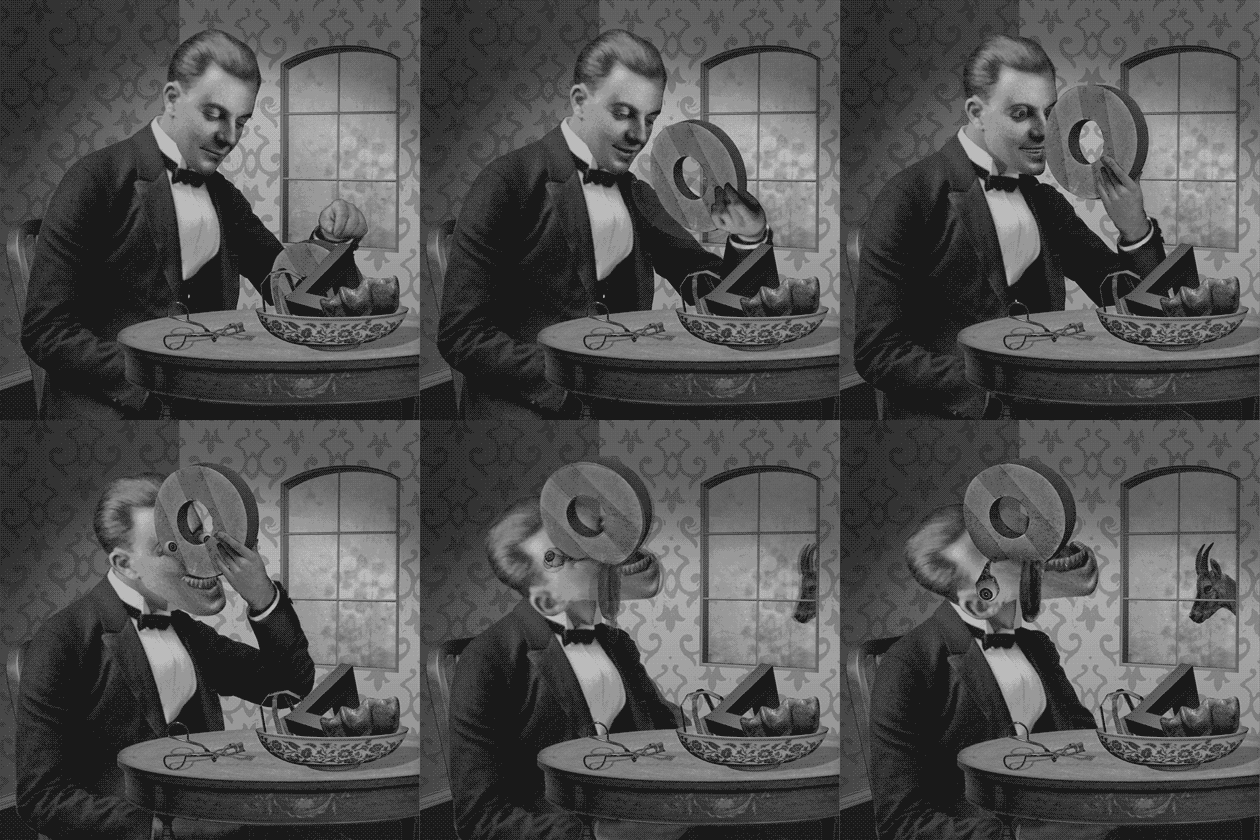
Other animations of his are a little more bizarre like the one below of a man with a goat looking through the window. He cites several Dada artists and pioneers as his sources of inspiration, one of which we’ve read of beforeβ€” Hannah HΓΆch, a pioneer of photomontages. Raff also refers to John Heartfield who was also another pioneer of photomontages, and Max Ernst, who was a Dada and surrealist painter, sculptor, and collage artist.

A man with a goat in the window.
Hannah HΓΆch, “Das schΓΆne MΓ€dchen [The Beautiful Girl]”Β (1920).
John Heartfield, “Der Sinn von GenfΒ [The Meaning of Geneva AIZ Cover]” (1932).
Max Ernst, “The Eye of Silence” (1943). [Courtesy of www.Max-Ernst.com]

If you enjoy feeling unsettled and need inspiration for your animations, check out more of Colin Raff’s work on his Instagram account and on his Youtube channel for his longer animations.

The Mystery of Mixografia

At the Helen Frankenthaler exhibition on Tuesday, you may have noticed that some of her works had ‘mixografia’ listed as one of the media. Sirocco (1989) is one such work that we saw at the “Frankenthaler on Paper” exhibition.

Helen Frankenthaler, “Sirocco” (1989). [Photo: Courtesy of Mixografia]

It’s a strange word, and even stranger and fascinating medium. Mixografia is actually the name of a printmaking studio founded in 1984 by Luis and Lea Ramba, as well as the name of the process the family has used in making three-dimensional prints. They use water and fibers as raw material to produce their own paper with fine details in texture. To add the necessary colors to pieces, they also make copper printing plates that get inked with the appropriate colors, which are then pressed into the paper.

Luis Ramba, center, in the workshop [Photography by Eric Minh Swenson]

The results of this process are incredible, allowing artists to make unique, complex works. The piece shown in the workshop photo above is Ed Ruscha’s Rusty Signs – For Sale (2014).

Ed Ruscha, “Rusty Signs – For Sale,” 2014. [Photo: Courtesy of Mixografia]

Check out some other incredible works below! As our class is not privy to making three-dimensional prints for Project 1.3, how can we recreate the appearance of textures in Illustrator or Photoshop? What brushes, symbols, or effects could help bring our invisible cities to life? (And yes, the work below called Have a Nice Day, Thank You! Plastic Bag (2016) by Analia Saban really is made out of paper).

Analia Saban, “Have a Nice Day, Thank You! Plastic Bag,” 2016. [Photo: Courtesy of Mixografia]
Tom Wesselmann, “Nude With Yellow Tulips” (2004). [Photo: Courtesy of Mixografia]
Louise Bourgeois, “Crochet IV,” 1998. [Photo: Courtesy of Mixografia]

Finding Inspiration From Microbes to Mosques

For our project 1.1 studies, I was drawn towards organic designs and consequently revisited an artist I follow for embroidery inspiration.

Emily Botelho (@salt_stitches) is a textile artist that creates strange alien-like worlds from myriad threads, beads, and fabric stitched with embroidery hoops. Each symphony of carefully placed beads and partial ‘pom pom’s from earthy, moss-inspired color palettes seems relevant to our exploration with layers and effects in Illustrator. In a soundscape or an acoustic environment, Botelho’s use of soft threads could translate to natural winds or the air-conditioner in the background. The cluttered beads could represent sharper and more distinct noises.

Botelho’s work reminded me of these colorful photos of microbes captured by synthetic biologist Tal Danino from the Synthetic Biological Systems Lab at New York City’s Columbia University.

Danino was able to create these patterns by manipulating the growing conditions for each bacteria. Harvard microbiologists Scott Chimileski and Roberto Kolter also captured photographs of microbiomes such as the koji microbe below which is used to make soy sauce, sake, and miso. This natural arrangement of the microbe’s spores almost already appears as an abstract art piece.

Koji, a fungus microbe

Another unlikely source of inspiration for project 1.1 came for me from the interiors of mosque domes. The repetition of intricate patterns in a circular form could be done in Illustrator using pathfinder.

Shaykh Lotfollah Mosque (Isfahan, Iran) [Photography by Rizzoli]

While mosque architecture seems to be more methodological and rigid than the organization of microbes or Botelho’s embroidery, its equally dizzying array of colors and almost clashing swirls and jagged lines create its own unique adventures for the eyes.

P. Valide Mosque Dome
Pertevniyal Valide Sultan Mosque (Istanbul, Turkey) [Photography by Harold Dixon]
Wazir Khan Mosque (Lahore, Pakistan) [Photography by Salman Arif]